.png)
Your Guide to Patio Screen Replacement Cost in Volusia County (Minus the Financial Freak-Out)

So, your patio screen has all the structural integrity of a wet paper towel. You’re picturing your bank account weeping as you Google "patio screen replacement cost," but let's pause the financial horror movie. A typical rescreen for a 200-square-foot enclosure right here in sunny Volusia County often lands between $400 to $800, making it a surprisingly manageable fix for our storm-battered screens.
Unraveling the Mystery of Screen Replacement Costs (Spoiler: It's Not Magic)
Let’s just rip the Band-Aid off, shall we? When a screen panel goes kaput, it’s easy to imagine your wallet is about to get a matching hole. But the reality is often way less painful than a stubbed toe in the middle of the night.
The total cost isn't some mystical number plucked from the humid Florida air; it's a predictable sum of a few key ingredients. Think of it like a recipe for a bug-free utopia: a little bit of material, a dash of skilled labor, and a sprinkle of "how-on-earth-do-we-get-up-there" complexity.
Understanding these moving parts is the first step to feeling like the captain of your own home-repair ship. Instead of just seeing a final number on an invoice, you’ll see the logic behind it. This knowledge transforms you from a worried homeowner into a savvy consumer who knows exactly what they’re paying for. And the good news? When it comes to patio screen replacement costs, most homeowners are pleasantly surprised.
Major U.S. markets, including our own Volusia County, see costs that are much more budget-friendly than a full enclosure rebuild. Data from across the country shows the average cost to rescreen a porch or patio enclosure ranges from $400 to $800, which breaks down to roughly $2 to $4 per square foot. You can explore more about these national averages on HomeGuide to see how our local prices stack up.
Quick Guide to Volusia County Screen Replacement Costs
To give you an even clearer picture, here’s a snapshot of what you can generally expect for common jobs right here in Volusia. Think of this not as a formal quote, but as a financial appetizer to help you get a feel for the situation.
Type of Repair | Typical Low-End Cost | Typical High-End Cost | Best For |
|---|---|---|---|
Single Wall Panel | $85 | $150 | A rogue golf ball, a feisty raccoon, or other minor acts of suburban chaos. |
Single Roof Panel | $125 | $250 | Damage from falling branches or wear and tear on those hard-to-reach top panels. |
Multiple Panels (3-5) | $250 | $600 | Addressing several aging or damaged sections at once for better value. |
Full Enclosure Rescreen | $400 | $800+ | A complete refresh when multiple screens are brittle, discolored, or storm-damaged. |
This table provides a solid starting point for budgeting. Whether you're dealing with a minor annoyance or what feels like a catastrophic failure, there's a solution that fits. You can also discover more about the nuances of repairing pool screens in our dedicated articles.
Now that you have these ballpark figures in mind, let’s dive deeper into what actually drives these prices up or down.
Breaking Down Your Screen Repair Quote, Piece by Piece
Ever get a repair quote that looks like it was written in a foreign language? You see a bunch of line items, some jargon, and a final number that feels like it was pulled out of a hat. Let’s demystify that bill. A patio screen replacement quote isn’t some dark art; it’s really just a combination of a few key ingredients.
Think of it this way: you’ve got the screen material, the hands-on sorcery to install it, and any special circumstances that make the job trickier. That’s it. Once you understand how those three things add up, you'll be able to read any quote with the confidence of a seasoned pro.
This chart gives you a bird's-eye view of how the costs branch out, whether you're fixing a single busted panel or going for a full rescreen.
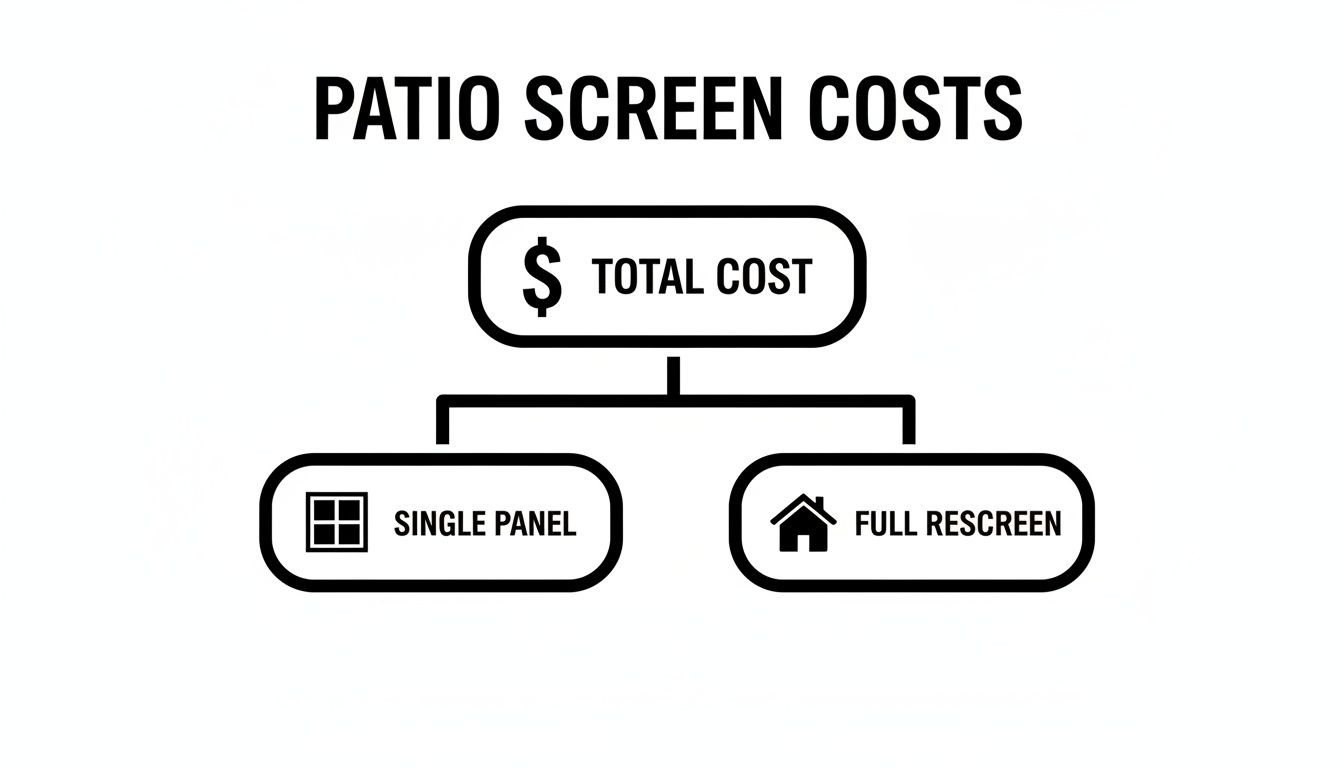
As you can see, both jobs get you back to enjoying your bug-free oasis, but the scope of work is what really dictates the final price tag.
The Screen Itself: Your First Line of Defense
First up, let's talk about the actual screen mesh. Here in Volusia County, there's one clear winner that nearly every pro uses: Phifer 18×14 mesh. It’s the local standard for a reason. This stuff is the Chuck Norris of screen material—tough enough to stand up to our wild Florida weather while still giving you a crystal-clear view.
Surprisingly, the material itself isn't the most expensive part of the equation. It's the foundation of your fortress against mosquitos and no-see-ums, but it’s not what sends the bill soaring. The real cost is in what it takes to get that screen installed perfectly.
The Human Touch: The Labor Factor
This is the big kahuna. Labor is where the magic happens, and it's so much more than just slapping up a new screen. It’s a genuine craft. It’s about getting that screen stretched to a perfect, drum-tight tension so it doesn’t look like a droopy, sad sack a month later. It's about meticulously rolling the spline into the frame's groove without a single slip, tear, or wrinkle.
This is where an experienced technician proves their worth. The skill, precision, and time required are why labor typically makes up the lion's share of your bill. It’s the difference between a DIY job that screams "I did it myself" and a professional installation that looks sharp and is built to last.
The numbers tell the story. Expert labor often runs $1.80 to $3.00 per square foot. In comparison, the top-tier Phifer 18×14 mesh only adds about $0.20–$1.00 per square foot. When you get a quote, you're not just paying for a roll of screen; you're investing in expertise.
The Degree of Difficulty: The Access Challenge
Finally, there’s the "how hard is it to get to?" factor. We call it access. Swapping out a ground-level panel right next to your patio door? That's a piece of cake. But replacing a panel two stories up, perched on a steep section of the roof? That's a whole different ballgame, my friend.
This part of the cost covers the extra equipment, risk, and time needed to do the job safely. It breaks down like this:
Ground-Floor Panels: These are the easiest and most affordable to replace. No special gear needed.
Second-Story Panels: Expect the price to go up. This job requires tall, sturdy ladders, safety harnesses, and a lot more setup time.
High Roof Panels: These are the most complex and dangerous. They demand specialized equipment and serious skill to pull off safely, which is always reflected in the patio screen replacement cost.
Once you understand these three pillars—materials, labor, and access—your quote suddenly makes sense. The numbers aren't random anymore; they're telling a clear story you can actually read. For an even deeper dive into these costs, check out HomeGuide's comprehensive analysis.
Real Scenarios and Sample Estimates in Volusia County
Okay, enough with the theory. Let's get down to what this really costs when life happens. Abstract numbers are fine, but what does the bill look like after your kid’s science fair rocket makes an unscheduled landing in your lanai? Or when a Florida hurricane leaves your enclosure looking like it lost a fight with a giant blender?
Let's walk through a few all-too-common scenarios we see every week here in Volusia County. Think of these mini case studies as getting a peek at your neighbor’s invoice—without having to make awkward small talk over the fence. We'll break down the job, the headaches, and a ballpark cost for each.
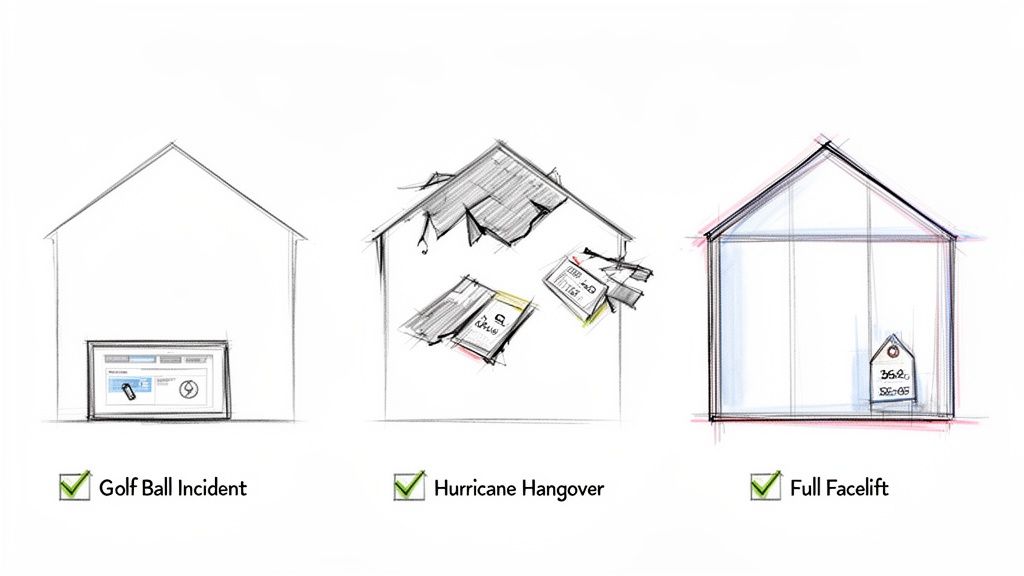
Case Study 1: The Golf Ball Incident
This is a classic. A slightly sliced tee shot, a stray baseball from next door, or even a particularly stubborn raccoon leaves you with a single, perfectly punctured lower wall panel. It's an eyesore, a flashing neon sign for every mosquito in a five-mile radius, and it needs to be fixed yesterday.
The Job: Replace one standard-sized lower wall panel using our go-to durable Phifer 18x14 mesh.
The Challenge: Honestly, there isn't much of one. This is about as straightforward as it gets. Access is a breeze, no special ladders are needed, and the whole thing is usually done in under an hour.
Sample Cost Breakdown: The main thing you're paying for here is the minimum service charge to get a pro out to your house. While the screen itself isn't expensive, the price reflects the time, travel, and skill to get that panel drum-tight and looking perfect again.
Estimated Cost: $85 – $150 This gets the hole gone and covers the service call, a new professionally installed panel, and the peace of mind that comes with a proper fix.
Case Study 2: The Hurricane Hangover
A big storm just blew through DeBary, and a few of your screen panels have officially given up the ghost. It's not a total catastrophe, but you’ve got a couple of roof panels flapping sadly in the breeze and maybe a wall panel that lost an argument with a flying tree branch.
This is a classic multi-panel repair. It's more work than a single panel, sure, but it's also where you start to see some real value by bundling the fixes. We handle these all the time; you can see more about our approach to pool screen repair in DeBary and how we tackle these common post-storm jobs.
The Job: Replace three busted panels—two on the roof and one on a hard-to-reach second-story wall—with new Phifer 18x14 mesh.
The Challenge: Access. That's the name of the game here. Those roof and second-story panels mean breaking out the extension ladders, using safety gear, and spending a lot more time and precision to get the job done right.
Sample Cost Breakdown: * Labor: The main cost driver is the complexity and risk of working at height. * Materials: Three panels' worth of Phifer mesh and fresh spline. * Value: By tackling all three at once, you’re saving a bundle by avoiding separate service call fees for each individual panel.
Estimated Cost: $300 – $550
Case Study 3: The Full Facelift
Your screen enclosure has served you well for over a decade, but the party's over. The screens are brittle, faded, and look like they'll tear if you just stare at them too hard. This isn’t about fixing one or two boo-boos; it's a complete refresh for the whole structure. We see this a lot in older Ormond Beach homes where years of sun and salt air have taken their toll.
The Job: A complete rescreen of a standard 20x20 lanai, replacing every single wall and roof panel.
The Challenge: This is a much bigger project, often taking a full day. The real challenge is maintaining meticulous quality and efficiency to ensure every last panel is perfectly tight and uniform. No saggy screens allowed.
Sample Cost Breakdown: This is a volume job, so the price per panel drops way down. Since the technician is already on-site with all the materials, you're essentially paying for a full day of expert labor and a bulk order of screen mesh. The result? A total transformation of your outdoor space.
Estimated Cost: $500 – $900+
How to Get a Killer Quote Without Losing Your Mind
Getting a quote for your screen enclosure shouldn't feel like you’re trying to buy a used car on some dusty lot. It needs to be simple, crystal clear, and leave you feeling confident—not confused.
Let's ditch the anxiety. I’m going to arm you with the insider secrets to securing a fair, accurate, and surprise-free estimate for your patio screen repair. A little prep work on your end transforms a vague phone call into a productive conversation where you get the real numbers you need to make a smart decision.
Prime Yourself for Quoting Success
Before you even think about picking up the phone or filling out a form online, gather a little intel. Having this info ready makes you a screen company’s favorite kind of customer—the one who helps them help you faster.
Here’s your pre-quote checklist:
Snap Some Photos: A few clear pictures of the damaged panels and one wider shot of the whole enclosure are gold. A picture is truly worth a thousand words (and can save a lot of back-and-forth).
Grab Rough Measurements: Don't worry, you don't need to be a structural engineer. Just use a tape measure to get a rough width and height of the panels that need fixing. Even a ballpark number is a huge help.
Note the Location: Is the damage on the ground floor? Or is it a tricky second-story panel that’s going to require ladders and some serious guts to reach? Be ready to describe the access.
With these three things in hand, you’re no longer just "the person with a hole in their screen." You’re an informed homeowner ready to have a real conversation about your patio screen replacement cost.
Spotting the Pros from the Pretenders
Let's be honest, not all screen companies are created equal. You’re looking for a partner, not a future problem. A trustworthy pro will be transparent from the very first conversation. One of the biggest green flags? A clear, easy-to-use online pricing cart. It shows they have nothing to hide and are confident enough to put their pricing right out there.
A truly professional quote is built on accurate data. To truly get a killer quote and ensure accuracy from your service provider, understanding the tools they use, such as specialized estimating software for contractors, can be highly beneficial.
On the flip side, here are some red flags that should make your spidey-senses tingle:
Vague "Over-the-Phone" Quotes: If someone gives you a firm price without seeing a single photo or asking detailed questions, run.
High-Pressure Sales Tactics: "This price is only good for today!" is a classic trick. A good quote from a reputable company should be valid for a reasonable amount of time.
No Online Presence or Reviews: In this day and age, a reputable local business will have a digital footprint. If they're a ghost online, be careful.
Unmasking Those Sneaky Hidden Fees
The number one way a "great deal" turns sour is through hidden fees that magically appear on the final invoice. It's a classic bait-and-switch. Your best defense is to ask about these potential add-ons upfront so there are absolutely no surprises when the bill comes.
Here are the common culprits to ask about:
Trip or Service Charges: This is a standard fee that covers fuel and travel time. Just make sure it's included in your initial quote, not tacked on at the end.
Disposal Fees: Are they going to haul away the old, damaged screen material? Some companies actually charge extra for this, so it’s worth asking.
Spline Replacement: Every new screen panel needs new spline to hold it in place. This should always be part of the per-panel cost, but it never hurts to confirm.
A little market knowledge also gives you an edge. When you look at historical trends in patio screen replacement costs, prices have thankfully stabilized after the post-2020 inflation madness. Pure rescreening is holding steady at $2–$4 per square foot, a welcome drop from the 2016 peaks driven by aluminum shortages. While costs in markets like Chicago ($1,500–$3,200) vary, our lovely Volusia humidity often means we need replacements about 20% more frequently. You can check out more details about these cost trends on King-Struction.
Repair or Replace? That Is the Question.
So, you're standing there, staring at your patio screen, wrestling with that classic homeowner dilemma. Is that one little tear just a quick patch job, or is it the first sign that the whole panel is on its way out? It's the age-old debate: do you slap a Band-Aid on it or is it time to call in the surgeon?
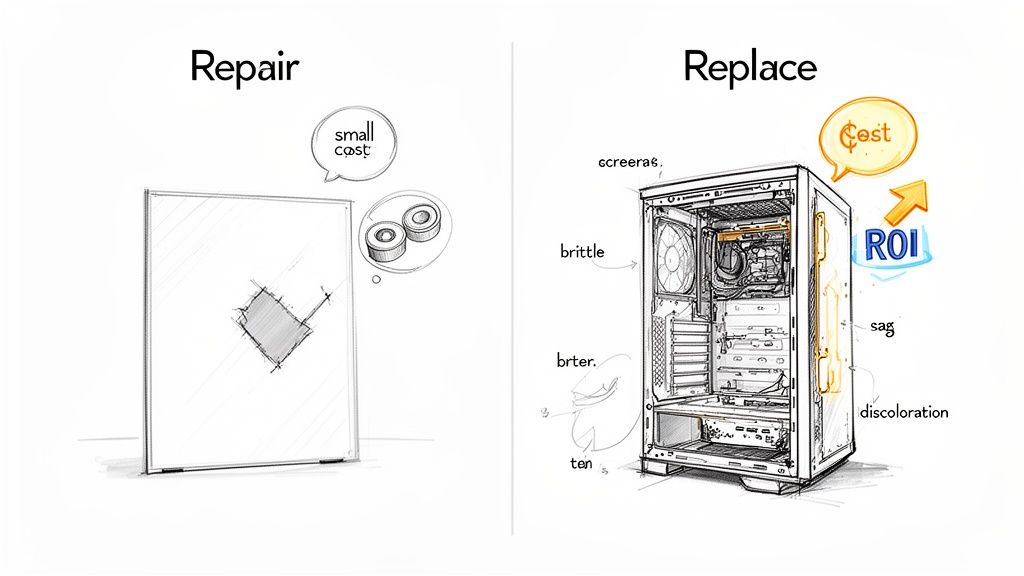
Let's be clear, this is about more than just looks. A tight, flawless screen enclosure is a serious asset that boosts your home's value and livability. Think of it as an extension of your living room—one that tells potential buyers "this place is well-cared-for and move-in ready."
How to Tell When Your Screens Are Waving the White Flag
Your screens will absolutely tell you when they've had enough. You just have to know what to look for. They have a language of wear and tear, and it’s usually more than just a single, clean rip from a stray branch. We're talking about systemic failure here.
Keep your eyes peeled for these dead giveaways that it's time for a full replacement:
The Brittle Test: Go ahead, give a corner of the screen a gentle poke. If it feels crispy and cracks with just a little pressure, it's lost all its flexibility. That screen is done.
Fading to Gray: That harsh Florida sun is no joke. If your once-black screens are now a sad, silvery-gray, the protective UV coating has completely worn off, leaving the material weak and vulnerable.
The Dreaded 'Screen Sag': Does your panel look more like a droopy old hammock than a taut drum? That sag means it has lost its tension and isn't really keeping the bugs out anymore.
Ignoring these signs isn’t just a cosmetic problem. It's an open invitation to every mosquito, no-see-um, and curious lizard in the neighborhood. Now, sometimes a targeted fix is all you need, especially for something like a single damaged roof panel. You can see how we handle a single roof panel replacement to get an idea if that’s a better fit for your situation.
The Smart Money: Bundling Panels for Big Savings
Alright, let's talk about the financial side of things. Is it actually cheaper to replace panels one by one as they fail, or does it make more sense to do a bunch at once?
Think of it like ordering pizza. Getting one slice delivered at a time would be crazy expensive and inefficient, right? You order the whole pie to get a better value.
The exact same logic applies to your patio screen replacement cost. Every single time a technician rolls up to your house, you're paying a base cost for their travel, time, and setup. Replacing one panel has to cover that entire trip charge plus the little bit of labor and material.
When you have a pro replace multiple panels in a single visit, you’re basically splitting that trip charge across all the panels. The cost per panel plummets because the technician is already there, tools in hand. It’s a simple economy of scale that puts money back in your pocket.
The numbers don't lie, especially after a storm rolls through. Following the 2022 storms, we saw a whopping 40% jump in claims here in Volusia County. While a small screen next to a window might run $147–$515 to replace on its own, enclosure panels become much more affordable when you bundle them.
Grouping multiple panels into one job is just a smart financial move. Data from across the industry shows that volume deals can slash your total bill by 10-15%. Don't just take our word for it—check out these cost-saving insights at King-struction.com to see the math for yourself. Making the right call between a spot repair and a larger replacement can easily save you hundreds in the long run.
Your Next Step to a Bug-Free Patio
Alright, you’ve made it. You've waded through the details, demystified the costs, and now you’re basically a screen repair guru. Seriously. You know the difference between a simple panel patch-up and a full-scale rescreening, and you can spot a flimsy quote from a mile away.
So, what now? All this knowledge is great, but it won't magically patch that hole that’s become a VIP entrance for every mosquito in the neighborhood. The good news is, you're just one small step away from turning that knowledge into a peaceful, bug-free lanai.
It's time for action.
Let's Tie It All Together
Think of this as your quick-and-dirty cheat sheet. Here's what we've learned:
Costs Are Just a Puzzle: The patio screen replacement cost isn't some mystical number. It’s just a simple sum of materials, labor, and how tricky the job is.
Quotes Can Be Trusted: You now know the right questions to ask to get an honest, no-surprises estimate.
Repair vs. Replace is a Judgment Call: You can now tell when it’s smarter to patch things up versus when you'll save money in the long run by replacing multiple panels at once.
This whole process is about so much more than fixing a tear. It’s about getting your outdoor space back—your morning coffee spot, your evening relaxation zone—without having to fight off winged invaders.
The final piece of the puzzle is finding the right people for the job. You're not just hiring a crew; you're inviting someone to your home. You want a local, family-owned team that gets it, communicates clearly, and treats your property with respect.
Ready to Make a Move?
We've laid all the cards on the table. You see the costs, you get the process, and you know exactly what to expect. No more guesswork or worrying about hidden fees.
The only thing left is to take that first easy step. Instead of putting it off, you can get a straightforward, no-nonsense estimate from a team that respects your time and knowledge. When you're ready to reclaim your patio, you can easily book a free estimate online with us.
Let’s get your sanctuary back.
Your Burning Questions About Screen Costs, Answered
Alright, so you've waded through the details of screen repair costs, dodged the confusing jargon, and you're just about ready to take back your patio. But hold on—a few last-minute questions are probably buzzing around your head, just like the mosquitos you're trying to evict.
Don't sweat it. We’ve heard every question under the Florida sun. Let's tackle those final uncertainties with some straight-up, honest answers.
How Long Does a Patio Screen Actually Last in Florida?
This is the big one, isn't it? Our screens are out there fighting the good fight every single day, taking a beating from relentless UV rays, soupy humidity, and the occasional hurricane-sized temper tantrum from Mother Nature. For a standard, quality fiberglass screen like a Phifer 18x14, you can realistically expect a lifespan of 7-10 years.
You’ll know its tour of duty is up when it starts to feel brittle and crispy. If your screen is turning a chalky gray or tears if you so much as glare at it, it’s officially waving the white flag. A friendly tip: gently hosing it down is fine, but for the love of all that is holy, do not take a pressure washer to it. You’ll slash its lifespan in half.
Is It Cheaper to Fix One Panel or Several at Once?
This is a classic "economy of scale" situation. Think of it like ordering pizza for delivery. If you order a single slice, that delivery fee makes it painfully expensive. But if you order the whole pie? The cost per slice drops dramatically. Screen repair works the exact same way.
Sure, fixing one rogue panel is the cheapest immediate fix for a single tear. But if you have a few panels looking a little long in the tooth, bundling them into one service call is always the smarter financial move. Here's why:
You only pay the trip charge once: Every visit includes a base cost for our time and gas.
The technician is already set up: All the tools, ladders, and materials are out and ready to go, making the work flow much faster.
You avoid multiple minimum service fees: Like most contractors, we have a minimum charge for any call-out.
Replacing three panels in one visit will always be significantly cheaper than calling us out three separate times for one panel each. If you're wrestling with this decision, our guide on pool screen repair advice dives even deeper.
Do Different Screen Types Jack Up the Cost?
You bet they do. The standard Phifer 18x14 fiberglass mesh is like the trusty Toyota Camry of the screen world—it’s reliable, affordable, and gets the job done beautifully. But when you need something with a little more muscle or a specific feature, you're looking at a premium.
For example, pet screens are the monster trucks of screen material. They're way thicker and tougher, designed to stand up to claws and paws. This extra durability comes at a 25-40% price increase and might slightly soften your view. In the same vein, "no-see-um" screens (a tighter 20x20 mesh) have a similar upcharge to keep those microscopic gnats from crashing your party.
According to Angi, while a massive national rescreening project can hit $2,900, the vast majority of smaller repair jobs stay well under $600. Interestingly, screen replacement has actually gotten about 20% cheaper per square foot over the last decade, falling from over $5 in 2015. To see how these numbers break down, you can learn more about these pricing dynamics.
Does a Panel's Height Change the Price Tag?
Absolutely. It all comes down to risk and hassle. A panel at ground level? That’s a walk in the park for our crew. But a panel way up on the second story, or worse, perched on a steep, slippery roof? That’s a whole different ballgame.
That extra charge, often called an "access fee," isn't just for show. It covers the cost of specialized extension ladders, safety harnesses, and the extra time and skill it takes to work safely at height. This is a standard and necessary part of the patio screen replacement cost, so be sure to mention exactly where your damaged panel is located when you call for a quote.
Ready to finally silence the buzz and reclaim your outdoor oasis? The team at Shiloh Screens LLC is here to deliver straightforward pricing and fourth-generation expertise for your Volusia County home. Get your free, no-nonsense estimate today at https://shilohscreens.com.


Comments